
Maximum Demand and Revenue
Also see: Video: Understand Your Study Results
Priceagent doesn't guess; it uses a proven, data-driven approach. Instead of relying on a simple cost-plus model, our platform analyzes how the market actually react to different price points for your product.
How we calculate our outcomes:
- Surveying Market: We ask a large group of your target customers regarding willingness to pay. This gives us a reliable dataset of price opinions.
- Mapping Demand: The system organizes this data to create a visual Demand Curve. This curve shows exactly how many people would be willing to buy your product at every possible price. The price with the most potential buyers is the one that gives you Max Demand.
- Predicting Revenue: We multiply each price point by its corresponding demand to project the potential revenue. This creates a Revenue Curve, which shows which price would be the most profitable. The highest point on this curve is your Max Revenue price.
By pinpointing these two key prices — max demand and max revenue— Priceagent empowers you to make smarter, more strategic decisions. You can choose to either drive higher sales volume or maximize your profitability, all based on what the market is actually willing to pay.
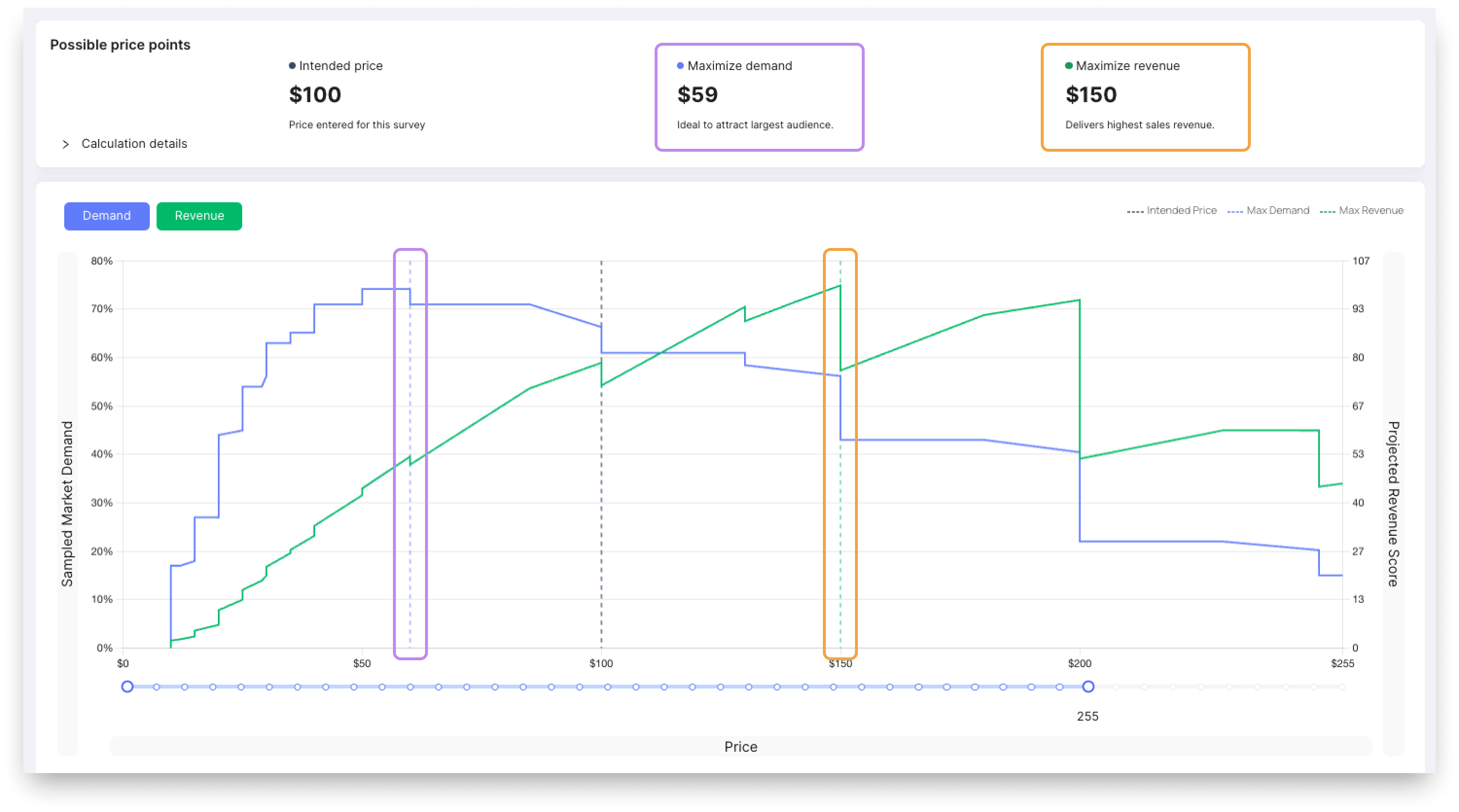
Maximizing Demand: The Key to Market Penetration
Understanding the price point that maximizes demand is crucial for companies focused on market share, new product launches, or capturing a new customer segment. While maximizing revenue is often the ultimate goal, sometimes the most strategic decision is to prioritize sales volume.
Priceagent’s demand curve pinpoints the exact price that will resonate with the largest number of potential buyers. This is not a guess based on competitor prices or an internal margin target; it is a data-backed conclusion based on real consumer feedback.
How to leverage your Demand curve and maximum demand point:
- Launch Strategy: For new products, setting a price at the Max Demand point can help you quickly build market share and customer adoption.
- Competitive Advantage: If you are in a highly competitive market, a Max Demand price can help you undercut rivals and attract a larger customer base.
- Market Expansion: When entering a new market or targeting a new demographic, a Max Demand price minimizes risk and provides a strong entry point.
By identifying your Maximum Demand price, Priceagent gives you the confidence to set a price that aligns with your business goals, whether that's to increase sales volume or simply get a foothold in a new market.
Maximizing Revenue: The Revenue Score
While the Max Revenue price shows you the single most profitable price point, the Revenue Score gives you a clear view of how every other price option compares. It’s a powerful tool for evaluating different pricing strategies at a glance.
The Projected Revenue Score is a simple, normalized metric that grades the potential of each price point on a scale from 0 to 100.
- 100 is the Benchmark: The price point that generates the absolute highest projected revenue is always assigned a perfect score of 100.
- A Clear Comparison: All other price points are then given a score relative to that maximum. For example, if a price point is projected to generate 80% of the maximum possible revenue, it receives a score of 80.
This score allows you to instantly see the revenue impact of choosing a different price. If your current price has a score of 65, you know you could potentially increase your revenue by 35% by adjusting to the optimal price point.
Comparison: Max Revenue & Max Demand
How do the curves differ? On each curve, there will be a max point, representing the point to Maximize Demand and Maximize Revenue. Here is a comparison about them:
Feature | Max Demand (Peak Reach) | Max Revenue (Revenue Score 100) |
What it represents | The price point that resonates with the largest number of buyers. | The price point that generates the highest total turnover. |
Primary Metric | % Demand: The percentage of the market you capture (0-100%). | Revenue Score: A scale of 0–100 (100 is the absolute max). |
The Trade-off | You achieve high volume but may leave potential profit "on the table." | You maximize profit but will see a drop in reach (fewer units sold). |
When to use it | Launch Strategy: Build market share quickly. Competitive Edge: Undercut rivals to attract a base. Expansion: Minimize risk in a new demographic. | Premium Positioning: For established brands. Profit Optimization: When you need to maximize ARPU. Supply Limits: When you have limited inventory. |
Read more on Possible Price Points.